For press and booksellers

Press kit

Everything needed to write about or list Win at 3 Card Poker. Cover art at print resolution, author photograph, descriptions at three lengths, and the facts. All of it free to reproduce in connection with coverage of the book.

The facts

Title
Win at 3 Card Poker
Subtitle
The Unofficial Strategy Guide
Author
Keith Adler
Subject
Gambling · mathematics · games
Structure
Fifty-five chapters in eight parts, plus ten appendices
Formats
Paperback and Kindle
Trim
6 × 9 inches
Extent
326 pages
ISBN
to come
Publication
to come
Price
$22.99 (US paperback)
Publisher
Keith Adler
Companion
The Simulator - free, no account

Descriptions

Three lengths, to be used as they are.

One line

The complete story of Three Card Poker - where it came from, how it is played, and exactly what it costs.

One paragraph

Three Card Poker is the friendliest game on the casino floor and one of the easiest to bleed money at. The decisions look small, so nobody learns them. Keith Adler traces the game from the first paper decks in Tang dynasty China to a British card player designing it on purpose in 1994, follows it across every American jurisdiction and out into Britain, Europe and the terminals that now deal it three times as fast - and works out its complete mathematics by counting every hand rather than estimating any of it. It is not a system and it does not beat the house. It is an admiring look at a very well-built machine, and at the small number of places where a player who pays attention does better than one who does not.

Full description

Nobody loses it all at once. It goes a little at a time - a hand folded that should have been played, a table chosen because it had a free seat, an hour that cost three times what the player thought it did.

Win at 3 Card Poker is the first complete account of a game most people think is too simple to study. Part history: six hundred years of cards, from Tang dynasty paper decks through Mamluk Egypt, primero, English brag and the New Orleans riverboats, to Derek Webb designing this game deliberately in 1994 around a single rule that makes the whole thing work. Part atlas: how the game is really dealt in Nevada, Atlantic City, the California card rooms, Oklahoma, the Gulf Coast, Britain, Europe and Macao - and online, live-dealer and stadium terminals, where the same correct play costs three times as much an hour simply because there is more of it.

And part arithmetic. Every figure in the book is produced by counting the game completely - all 22,100 hands against every hand the dealer can hold behind them - rather than by simulation. The reference implementation is published at github.com/keithadler/win-at-3-card-poker so any of it can be checked.

It is honest about what it is. Nothing in it beats the house edge. What it offers is the difference between playing a game well and playing it badly, which is a real difference, a larger one than most players expect, and entirely inside their control.

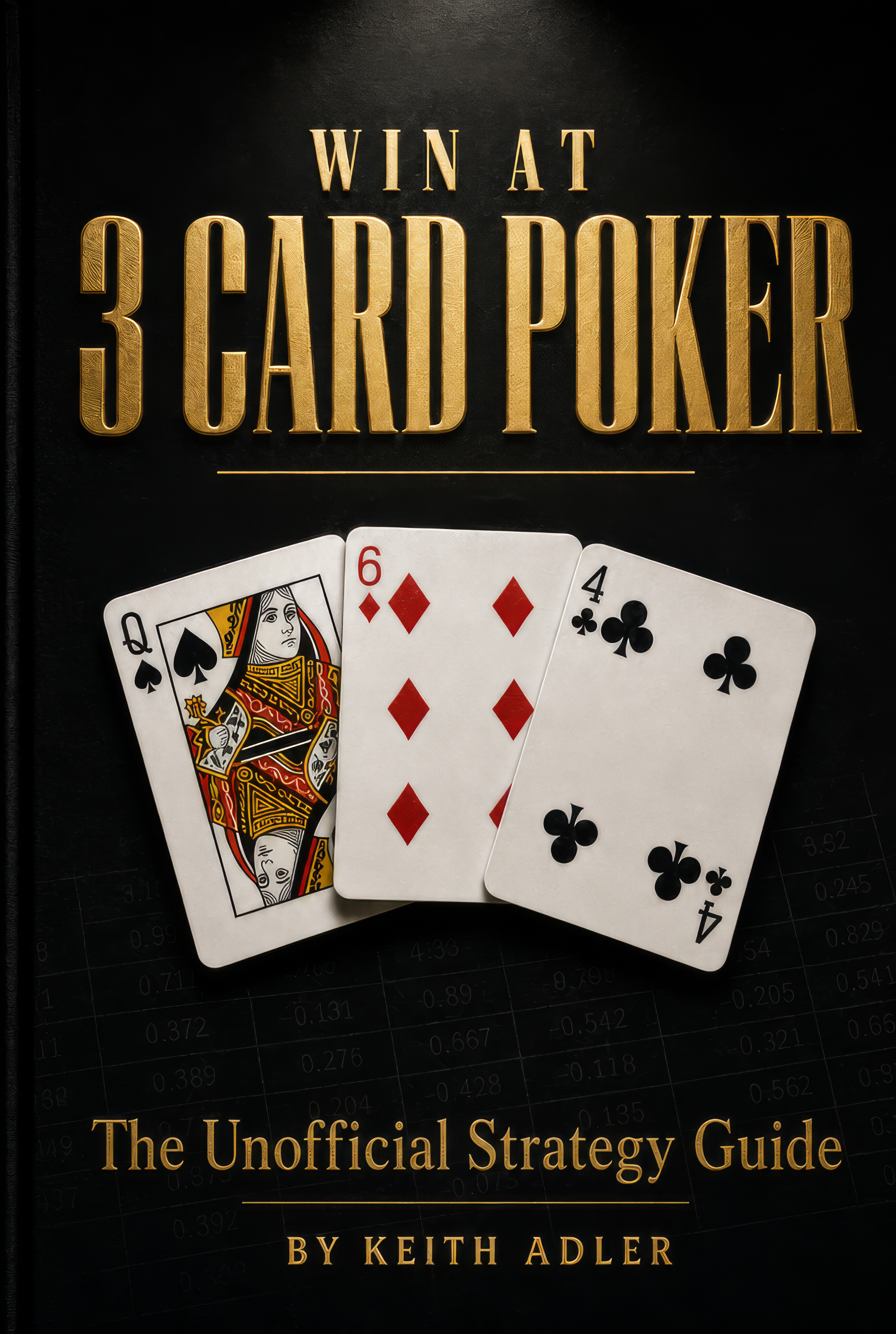
Cover art

Free to reproduce in connection with coverage.

Author photograph

Author biography

Short

Keith Adler writes fiction and non-fiction. He loves mathematics, his brother teaches mathematics, and he has an unhelpful habit of building the thing his books are arguing about before he will write a word of the argument.

Long

Keith Adler is the author of several novels, including The Aura Principle, The Saga for Donna, Thirty-One Mirrors and Young Cop, and of Win at 3 Card Poker. He loves mathematics - his brother teaches it, so the arguing started early - and he wrote the solver for this book before he wrote the book, on the suspicion that most of what gets repeated about a simple casino game had never actually been checked. He is interested in the game less as something to beat than as something very well made: it has held casino floors for thirty years and kept both sides of the table coming back, which is a hard thing to design.

Interviews and review copies

Advance copies, interviews and permissions: press@winat3card.com